Thermal Cooling: The Future of Industrial Energy Efficiency and Waste Heat Recovery
In times of rising energy costs and stringent climate targets, industrial cooling supply is gaining critical importance. Globally, approximately 17% of annually generated electricity is consumed for cooling purposes, causing carbon emissions of around 2.24 Gt CO2e/annum (accounting for 6% of global emissions). Adsorption chillers (AdCh) offer a future-proof solution by directly converting unused process waste heat into sustainable cooling. As a result, companies not only reduce their operational costs but also make an active contribution to the decarbonization of their production.
How Does Adsorption Cooling Work Physically?
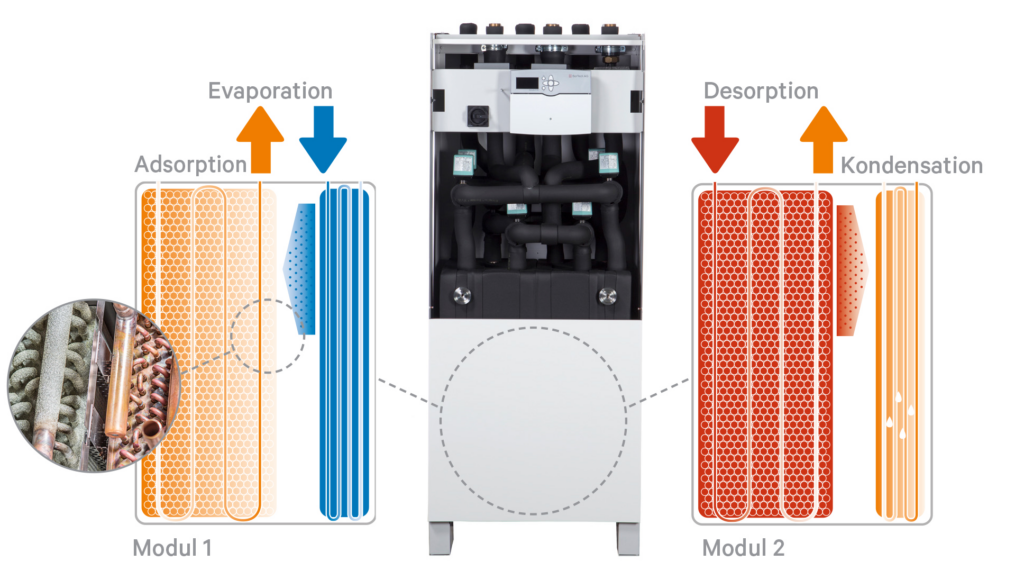
The adsorption chiller (AdCh) operates on a thermochemical principle that completely dispenses with the use of mechanical compressors. The process relies on the reciprocal adsorption and desorption of water vapor on a solid, porous surface—typically silica gel or zeolites.
In the evaporator, water is evaporated under vacuum conditions at low temperatures between 8 °C and 15 °C, with the resulting heat of vaporization extracted from the medium to be cooled. The resulting water vapor is subsequently bound by the adsorbent in the adsorber, maintaining a continuous vacuum in the evaporator system. To regenerate the water vapor-saturated adsorbent, external driving heat (between 55 °C and 90 °C) is supplied. This drives the water out of the sorbent, which is then liquefied in the condenser so that the cycle can begin anew. A key physical advantage of this process is thermal compression, where heat is released at a medium temperature level and must be dissipated via a cooling tower system. Since the compression process is thermochemical, no moving parts are required in the modules, ensuring extreme durability and robustness.
Adsorption
Water vapor molecules are bound by an adsorbent (e.g., silica gel or zeolites). This binding process creates a negative pressure (vacuum) that causes water in the evaporator to boil, thereby generating cooling capacity.
Desorption
The saturated adsorbent is dried by supplying drive heat (between 55 °C and 90 °C) to close the cycle.
Sustainability Through Natural Refrigerants
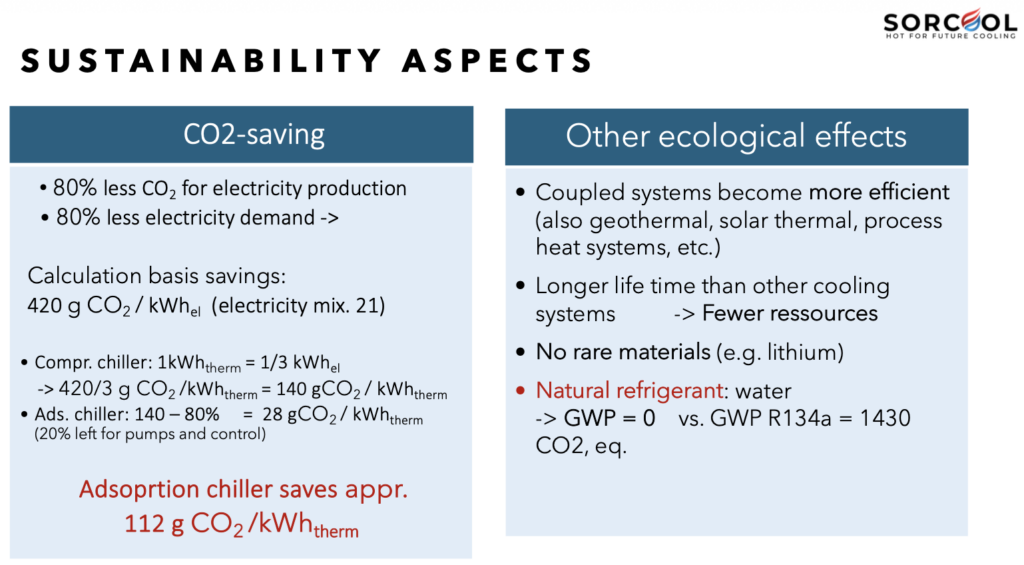
Unlike conventional compression refrigeration systems, the refrigerant used in adsorption systems is pure water. With a GWP (Global Warming Potential) value of 0, it is the most environmentally friendly alternative to synthetic refrigerants with a high greenhouse potential. In addition, the process saves up to 90% of electrical power compared to conventional systems.
Coupling of Compressed Air Waste Heat and Process Cooling
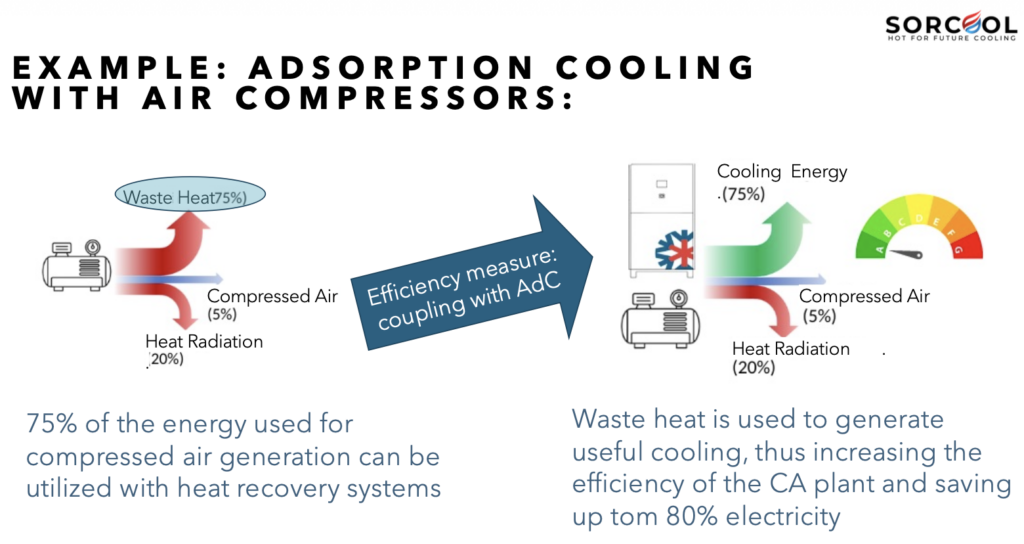
Adsorption systems (AdCh) unfold their potential through integration into existing industrial infrastructures, such as compressed air compressors. Up to 75% of the energy used in a compressor is lost as waste heat; this can be used to generate process cooling, significantly increasing the overall efficiency of the system. Efficient cooling generation completely without a mechanical compressor: This is how the thermodynamic principle of sorption cooling works.
Technical Specifications and System Design

| Performance Characteristic | Value / Range |
| Drive Temperature | 55 °C – 90 °C |
| Chilled Water Temperature | 8 °C – 19 °C |
| Thermal COP | bis 0.58 |
| Electrical EER | bis 30 |
| Cooling Capacity | 10 kW – 600 kW |
Scalable Solutions: Hybrid Chiller and Cascading
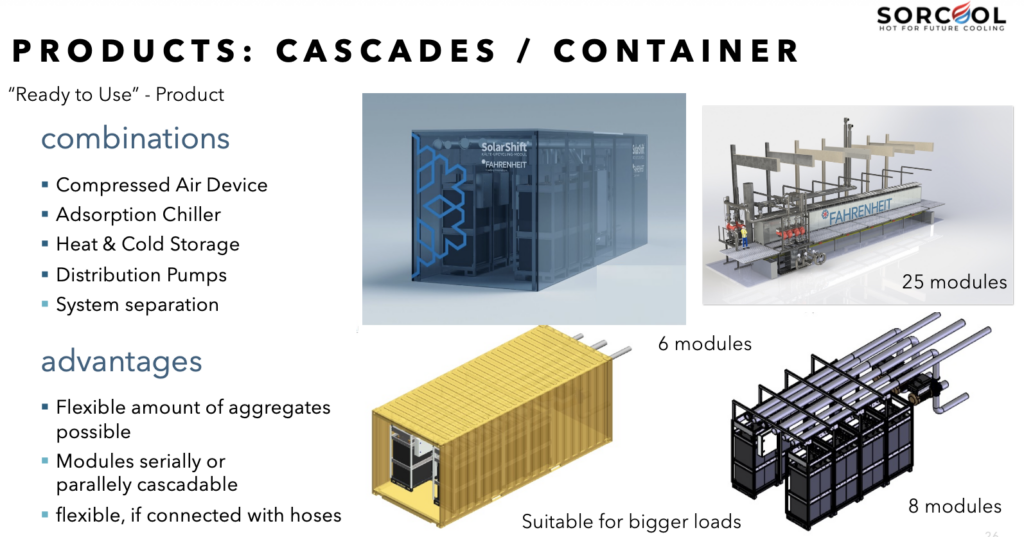
For high performance requirements, SorCool units can easily be cascaded. In addition, Hybrid Chillers offer a combination of adsorption cooling and modern compression refrigeration technology (using propane R290) to ensure precise air conditioning at all times when waste heat fluctuates.